
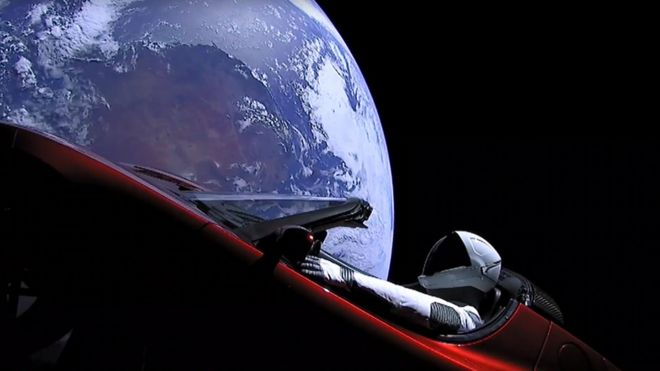
That's the conclusion of an analysis by Czech and Canadian researchers.
They calculated that the roadster has a 6% chance of colliding with Earth and a 2.5% probability of hitting Venus over the next million years.
But there's no cause for concern: if it eventually returns to Earth, most of the vehicle will burn up.
The man who sent his sports car into space
The team's computer simulations suggest there is a very slim chance of the vehicle colliding with the Sun, but little to no chance of the car hitting Mars.
The results have been published on the Arxiv.org pre-print server.
US entrepreneur Musk launched the car into space on 6 February, atop his new rocket, the Falcon Heavy - which is the most powerful launcher currently available.
The whimsical payload selected for the experimental flight was Musk's old cherry-red Tesla sports car.
A space-suited mannequin was strapped in the driver's seat, and the radio set to play a David Bowie soundtrack on a loop.
It was despatched into an elliptical orbit around the Sun that extends as far out as the Planet Mars.
Dr Hanno Rein and colleagues, ran a computer simulation 240 times to understand how the Tesla's orbit would evolve over the course of 3.5 million years.
"We did not know what to expect because the other near-Earth objects we see in space are asteroids and typically come from further out in the Solar System. In this case, it's the reverse. We know the object comes from Earth, so the question is where will it go from here," Dr Rein, an assistant professor at the University of Toronto, told BBC News.
"There were two possibilities, either it would stay with the terrestrial planets of the inner Solar System, or it would go further out where all these other asteroids and other Kuiper Belt objects are."
The researchers wondered whether long-term gravitational interactions - known as strong resonances - between the sports car and giant planets like Jupiter might draw the object outwards. But this did not seem to be the case.
Instead, the car's orbit over short and long timescales appears to be dominated by close encounters with the Earth. Over time, interactions with Venus become more common.
Dr Rein also allayed any fears, however unlikely, that a collision with Mars could contaminate the Red Planet with terrestrial bacteria, complicating scientific efforts to detect any indigenous microbes. "This thing will be in space for several million years before it hits anything," he told me.
Source: Bbc News


 Hello, my name is Jack Sparrow. I'm a 50 year old self-employed Pirate from the Caribbean.
No comments:
Post a Comment